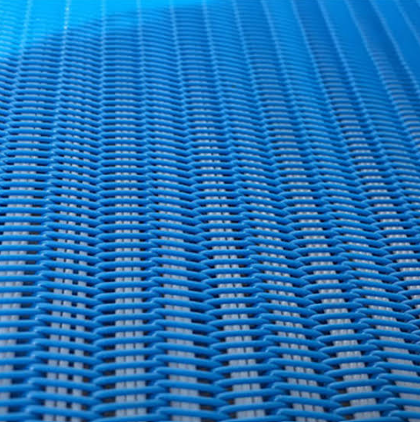
Developing a low-permeability spiral dryer fabric (typically rated between 50 to 250 CFM at 127 Pa / 0.5 in. H₂O) for paper machine dryer sections requires modifying raw material profiles, structural geometry, stuffer/filler yarn insertion, and thermomechanical finishing.
Standard open spiral fabrics usually exhibit high permeability (600–1000+ CFM). Lowering permeability is essential for high-speed single-tier dryer groups (blow box / Uno-Run setups) to minimize boundary air entrainment, sheet flutter, and edge drop-offs.
1. Raw Material Selection & Hydrolysis Resistance
Dryer sections subject fabrics to cyclic heat (100°C–150°C), constant tension, and saturated steam environments.
- Base Monofilament (Spiral Loops): High-intrinsic-viscosity polyester (PET) modified with anti-hydrolysis agents (e.g., carbodiimide-stabilized PET) to prevent ester chain cleavage from steam degradation.
- Pintle Wires (Hinge / Cross Wires): Round PET or polyphenylene sulfide (PPS) monofilaments. PPS is deployed when elevated operating temperatures (>130°C) or acidic chemical environments threaten rapid PET embrittlement.
- Filler / Stuffer Yarns: Flat or profiled PET/polyamide (PA) monofilaments, multi-channel yarns, or twisted spun/staple yarns engineered to occupy void volume within the spiral coils.
2. Geometric & Coil Structure Design
Low permeability is driven by tightening the mesh geometry before and during filling.
- Spiral Geometry (Small vs. Medium Loop): Use a small-loop architecture (e.g., loop height ~3.5–4.5 mm, loop width ~2.2–3.0 mm) rather than medium or large loops. Smaller loops create a denser contact area with smaller internal open voids.
- Flat Wire Shaping: Replacing conventional round wire coils with flat/oblong monofilaments increases the contact area against the paper sheet (improving heat transfer) and physically narrows the open gap between adjacent coil turns.
- Alternating Spiral Pitch: Left-hand (Z) and right-hand (S) spirals must be alternated and intermeshed with consistent overlap to maximize packing density along the machine direction (MD).
3. Filler (Stuffer) Yarn Engineering
Inserting stuffer yarns into the inner cavity of the interlinked spirals is the primary method to drop permeability from 800+ CFM down to 80–150 CFM.
| Filler Type | Typical Permeability Range | Key Performance Trade-off |
| Flat Profiled Monofilament | 150 – 300 CFM | Excellent aerodynamic stability; resists moisture absorption; easy to clean. |
| Multi-Filament / Texturized Yarn | 80 – 180 CFM | Fills interstitial voids thoroughly; slightly higher risk of picking up stickies/contaminants. |
| Spun / Blended Yarns | 50 – 120 CFM | Achieves ultra-low permeability, but can trap moisture and degrade faster under high-humidity paper-contact zones. |
| Dual/Compound Stuffer Wires | 60 – 150 CFM | Multiple shaped wires inserted per loop; ensures mechanical stability and zero shifting under tension. |
- Insertion Process: Profiled yarns are fed through the interior of each interconnected coil loop across the cross-machine direction (CD) prior to final tensioning.
4. Thermomechanical Setting (Heat Setting)
Precise heat-setting fixes the dimensional stability of the spiral links and locks the filler yarns in place:
- Pre-Tensioning: The fabric is mounted onto a heat-setting frame and subjected to longitudinal tension (typically 15–30 N/cm) and transverse guidance.
- Thermal Treatment: Pass through hot-air zones at 180°C to 215°C depending on resin grade. This induces thermal relaxation, eliminates residual internal extrusion stresses, and increases structural crystallinity.
- Loop Compaction: Under tension and heat, the interlocking coils compress tightly against the pintle wires and trap the stuffer yarns firmly against the coil walls, permanently sealing residual bypass apertures.
5. Edge Treatment & Quality Control
- Edge Sealing: The cut edges must be reinforced using ultrasonic melting, two-component high-temperature epoxy, or polyurethane resins across a 30–50 mm border to prevent pintle wire slippage and loop unravelling.
- Surface Planing / Sanding (Optional): Light mechanical abrading or calendering of the paper-side surface creates a smooth, flat sheet-contact profile to reduce sheet marking on fine paper grades.
- Permeability Testing: Continuous multi-point air permeability measurement (ASTM D737 / ISO 9237 standard) across the entire width to verify cross-direction profile uniformness (+- 5% tolerance).
- Diagonal Distortion (Skew) Verification: Spiral dryer fabrics are prone to diagonal racking; ensure squareness tolerance within <=2 mm/m to prevent fabric guiding and tracking instability on the machine.