SSB (Sheet Support Binder) forming fabric is currently the most widely used and technically advanced multi-layer forming fabric structure on modern high-speed paper machines. Its core design philosophy is to fully decouple the design of the “sheet support layer” and the “machine-side wear layer,” connecting them securely with dedicated binder yars.
Here are the specific structural characteristics and the core advantages they provide:
1. Structural Characteristics of SSB Forming Fabric
Standard double-layer or triple-layer fabrics usually connect the layers by allowing the load-bearing MD or CD yarns from one side to interweave into the other. This inevitably disrupts the uniformity of the sheet-side surface. The SSB structure, however, achieves true specialization:
A. Dedicated Sheet-Side Design (Top Side)
- Uses extremely fine yarn diameters and maximum possible warp/weft density.
- Typically utilizes a plain weave or its derivatives to form an exceptionally compact, tight, and smooth surface for fiber formation.
B. Dedicated Machine-Side Design (Bottom Side)
- Features very large, robust yarn diameters and maximum wear resistance (often using alternating monofilaments of Polyamide (PA/Nylon) and Polyester (PET)).
- The structure is relatively open to facilitate rapid drainage while providing high structural stability.
C. Unique Integrated Binder Technology (Intrinsic Binder)
- Unlike traditional triple-layer fabrics, which use extra added binder yarns that can cause surface protrusions and marking, SSB utilizes integral binder pairs (usually CMD binder yarns).
- These binder pairs alternate: when one is weaving perfectly with the sheet side to complete the smooth top surface pattern, the other is anchoring securely into the machine-side structure. At no point is there a gap or an irregular marking point on the surface.
Image 1: SSB Triple-Layer StructureThis diagram illustrates the integrated binder technology that defines SSB. It shows the detailed weave pattern, highlighting how the dedicated, fine sheet-side layer and the coarse, wear-resistant machine-side layer are seamlessly joined. Note how the colored binder yarns interlock the two layers without disrupting the smoothness of the top surface.
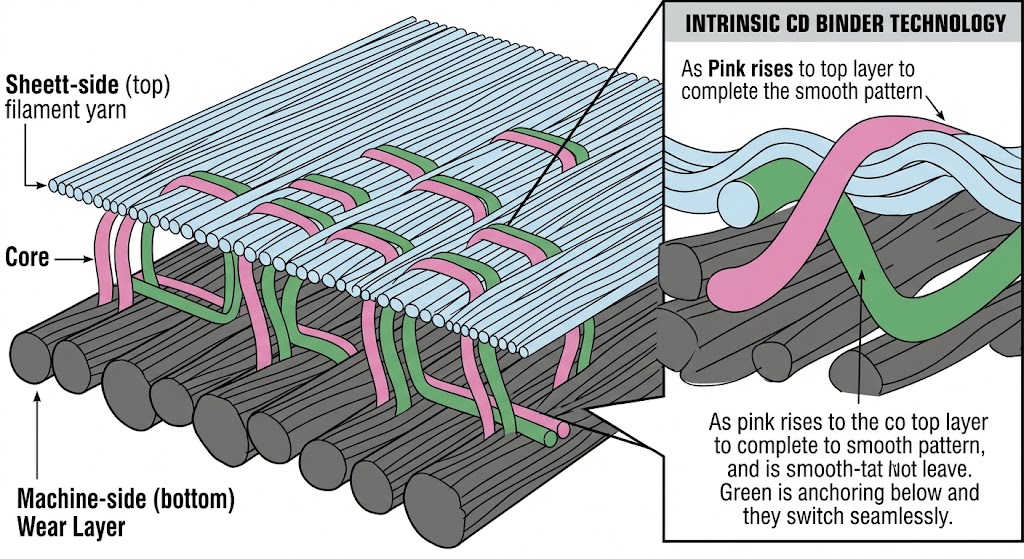
(Diagram: Image 1 shows a 3D cutaway of SSB weave, highlighting the fine top layer, coarse bottom layer, and the integrated binder pairs.)
2. Core Advantages of SSB Forming Fabric
By achieving a perfect separation and integration of both surfaces, SSB forming fabrics overcome the limitations of traditional designs, offering the following significant benefits:
1. Superior Sheet Quality (High Support, No Marking)
- Maximum Fiber Support (FSV): The incredibly fine sheet-side mesh provides optimal support for short fibers and fines, preventing them from bleeding through. This drastically improves Formation.
- Total Elimination of Wire Mark: Because the binders are perfectly integrated and hidden, there are no localized “hard points” or “cross-over marks” on the top surface. This is essential for printing papers, coated base papers, and lightweight tissue.
- Minimized Sheet Two-Sidedness: With uniform retention of fillers and fines, the difference in smoothness, ink absorption, and color between the top and bottom sides of the paper is minimized.
2. Perfect Balance of Drainage and Retention
- High Retention: The tight upper structure acts as a precision filter, significantly increasing the first-pass retention of fibers and fillers. This reduces the solids load in the white water system and lowers the consumption of retention chemicals.
- Optimized Straight-Through Drainage: Although the sheet side is fine, the SSB structure maximizes Internal Void Volume. Water passing through the top layer encounters no resistance and drains straight through the open bottom layer, preventing harmful lateral turbulence that disrupts formation.
3. Extreme Mechanical Stability and Long Lifespan
- Superior Wear Resistance: The machine-side layer can use extremely large, smooth, and wear-resistant warp and weft yarns, offering a much larger Wear Volume compared to traditional designs. It withstands the intense friction of high-speed operation and high-vacuum suction boxes.
- High Structural Stiffness (Stability): The integrated triple-layer architecture gives the SSB fabric exceptional CD (Cross-Machine Direction) stiffness (preventing curling and wrinkling) and MD (Machine Direction) stability (low stretch), ensuring the fabric runs stable, straight, and true at speeds exceeding 1500 m/min.
4. Excellent Cleanability and Contamination Resistance
The regular and straight-through nature of the internal void volume means the fabric does not easily trap stickies, resins, or fillers. The open structure is highly responsive to continuous high-pressure shower cleaning, maintaining stable air permeability over its lifespan.
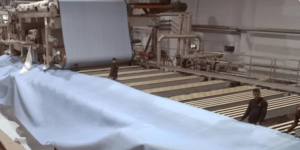
Image 2: SSB Fabric in OperationThis industrial photograph captures an SSB forming fabric operating on a high-speed twin-wire gap former. The fabric is running at high speed over suction boxes and forming rolls. The perspective emphasizes the extremely smooth, fine texture of the fabric surface where the sheet is formed, contrasting sharply with the robust, wear-resistant bottom side passing over the vacuum elements.
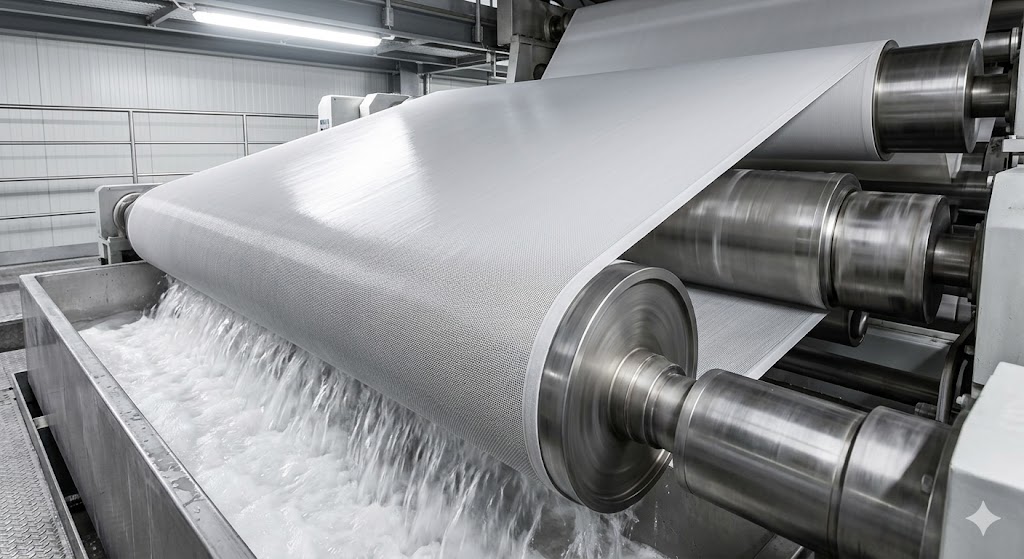 (Photograph: Image 2 shows an SSB fabric operating on a high-speed machine. Water is being removed through the robust bottom layer, while the fine sheet-side surface provides an extremely smooth formation table.)
Conclusion
Where traditional forming fabrics represent a series of compromises, the SSB forming fabric offers a “win-win” solution:
Sheet Side (Fine + High Retention) + Machine Side (Coarse + Durable)= High Quality Paper+ High Speed & Life
This is why SSB has become the standard forming fabric structure for modern high-speed Gap Formers and large board machines.
KEYLIFE, the main supplier of paper machine clothing in China, can offer SSB forming fabrics for all paper grades.