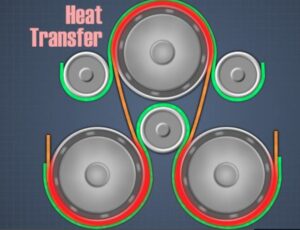
In paper manufacturing, the choice of dryer fabric has a massive impact on runnability, energy consumption, and paper quality. Both spiral and woven fabrics have distinct characteristics that make them suitable for different positions in the dryer section.
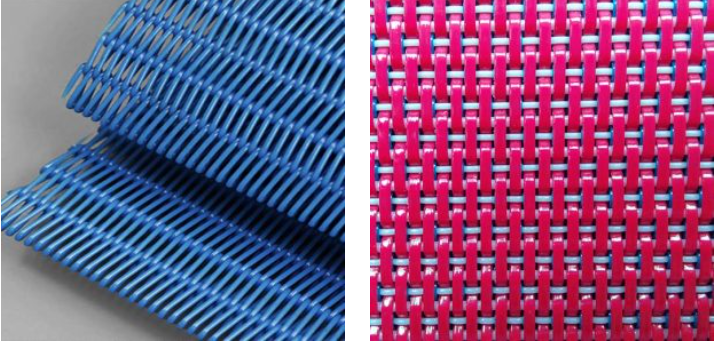
Here is a breakdown of the advantages and disadvantages of each.
Spiral Dryer Fabric
Spiral fabrics are constructed by joining together individual, helical plastic loops with a pintle wire. Because they don’t have a traditional yarn weave, they behave quite differently from woven fabrics.
Advantages
High and Stable Permeability: The open structure allows for excellent air ventilation and mass heat transfer, which can increase drying efficiency.
Extreme Durability & Long Lifespan: Because there are no warp and weft yarns to rub against each other, internal wear is minimized. They are highly resistant to mechanical damage and distortion.
Easy to Repair and Seam: If a section is damaged, you can literally cut out the bad part and zip in a new piece using a pintle wire. The seam is virtually identical to the fabric body, minimizing seam-mark risks.
Easy to Clean: The open, non-interlocking nature of the loops makes it harder for contaminants (like dirt, resin, or stickies) to get trapped, and they respond very well to high-pressure showers.
Disadvantages
Potential for Fabric Marking: The surface profile is rougher and more prominent than a woven fabric. This can leave “spiral marks” on delicate or lightweight paper grades.
Higher Internal Air Turbulence: At very high speeds, the large void volume can carry too much air, causing sheet fluttering or drops on modern, high-speed machines.
Higher Initial Cost: They are generally more expensive upfront than standard woven fabrics.
Woven Dryer Fabric
Woven fabrics are made using traditional weaving technologies (typically 3, 4, or 5-shed designs) using monofilament or multifilament yarns.
Advantages
Smooth Surface (Low Marking): Woven fabrics can be engineered with flat warp yarns to create an incredibly smooth surface. This is critical for high-quality, fine paper grades where sheet marking must be avoided.
Better Sheet Contact: The flatter surface provides a larger contact area between the paper sheet and the dryer cylinder, optimizing conductive heat transfer.
Aerodynamic Stability: They can be woven tightly to control permeability and minimize boundary-layer air movement, reducing sheet flutter on ultra-high-speed paper machines.
Lower Initial Cost: They are generally more economical to purchase initially compared to spiral fabrics.
Disadvantages
Vulnerability to Seam Failure: The seam is often the weakest point of a woven fabric. If the seam wears out or breaks, the entire fabric usually needs to be replaced.
Prone to Distortion and Narrowing: Under high tension and heat, woven fabrics can experience dimensional stability issues, such as narrowing or bowing.
Harder to Clean: The intersecting points of the warp and weft yarns create tiny pockets where filling, sizing, and stickies can easily accumulate, leading to a steady drop in permeability over time.
Quick Comparison Summary
| Feature | Spiral Dryer Fabric | Woven Dryer Fabric |
| Primary Strength | Lifespan, wear resistance, easy repair | Surface smoothness, sheet contact |
| Best Suited For | Packaging, board, pulp drying, and positions prone to high wear/contamination | Fine paper, newsprint, lightweight grades, and high-speed positions |
| Cleanability | Excellent | Moderate (prone to clogging) |
| Seam Strength | Equal to the fabric itself | Weakest point of the fabric |
| Risk of Marking | Higher | Minimal |
KEYLIFE has a porforlio of spiral dryer fabric and woven dryer fabric to cater the need of all paper machines