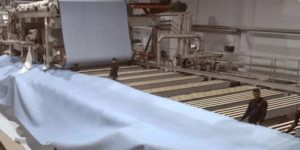
Manufacturing a wide press felt (typically >8–10+ meters wide, designed for high-speed, wide paper machines) involves a significant step-up in complexity and cost compared to a standard/normal width felt (typically 4–6 meters wide).
The challenges stem from exponential physics: doubling the width does not just double the cost—it significantly increases mechanical deflection, yarn tension imbalance, profile unevenness, and capital requirements.
1. Key Manufacturing & Operational Technical Differences
| Aspect | Standard Width Felt (4–6 m) | Wide Press Felt (8–10+ m) |
| Capital Equipment (CapEx) | Standard wide-loom, needle loom, and heat-setting equipment. | Massive heavy-duty looms, ultra-wide needle looms, and high-tonnage thermal setting cylinders. |
| Cross-Machine Tension Control | Standard warp/weft tensioning. | Extreme tension control required across the entire length/width to prevent center-sag or edge-tightening. |
| Needle Punching Uniformity | Standard multi-pass needle punching. | Exponentially higher risk of needle marks, density variation, or profile mass non-uniformity across the width. |
| Heat-Setting & Thermo-Fixation | Standard temperature zone controls. | Precise multi-zone thermal management needed to prevent dimensional warping, bow, or skew. |
| Quality Control & Testing | Standard cross-direction (CD) weight, thickness, and air permeability testing. | High-resolution scanning across 800–1000+ cm to eliminate micro-variations that cause sheet marking or localized dewatering issues. |
2. Difficulty Breakdown: Why Wide Felts are Harder to Produce
A. Weaving & Structural Stability
- Loom Tension & Deflection: Over wide spans (e.g., 9.5 meters), the structural loom rolls experience significant mechanical deflection. Maintaining uniform tension across thousands of individual warp threads requires specialized heavy-duty machinery.
- Bow and Skew Risk: A slight mismatch in thread tension causes the base fabric to bow or skew during weaving or thermal setting, leading to dimensional instability on high-speed paper machines.
B. Needle Punching & Batt Attachment
- Batt Profile Uniformity: Achieving uniform basis weight (gsm) across an 8–10 meter width is technically demanding. Localized density variations will result in uneven moisture profiles or shadow marking on the paper web.
- Needle Loom Precision: Ultra-wide needle looms require rigid beam structures to prevent center vibration, which causes uneven needle penetration depths.
C. Thermal Setting & Polymer Processing
- Heat Distribution: Thermo-fixing polyamides (PA6 / PA6.6) requires strict cross-directional temperature stability. A variance of just a few degrees across the width causes non-uniform elastic recovery, permeability variations, or width shrinkage differences.
3. Cost Drivers Comparison
- Capital Investment (Machinery):
- Normal Width: Standard loom and finishing lines have lower capital cost and broader supplier availability.
- Wide Width: High-capacity ultra-wide weaving looms and heavy-duty needle lines require massive initial capital expenditure and specialized foundation engineering.
- Raw Material Efficiency & Scrap Rates:
- Normal Width Felt: Lower scrap rate during trimming, seam preparation, and edge cutting.
- Wide Width Felt: Defect-driven scrap is substantially more expensive. If a quality flaw occurs on an 800 gsm wide felt near the end of processing, the raw material loss (yarn, batt fiber, energy) is twice to three times as high.
- Labor & Skill Level:
- Wide felt manufacturing requires experienced master technicians to manage manual seam insertions, multi-zone thermal balancing, and complex profile adjustments.
- Logistics & Handling:
- Special packaging, heavy-duty hoisting equipment, and oversized freight/container shipping add incremental handling costs for wide felts.