In the papermaking process, the press section plays a critical role in determining both the quality of the paper and the overall energy efficiency of the mill. Strikingly, mechanical water removal in the press section is roughly 10 times cheaper than thermal drying in the dryer section.
At the center of this process is the press felt (historically called a press blanket). The evolution of press felt technology is a narrative of engineering transitioning from basic, natural materials to highly complex, customized polymer structures capable of withstanding immense speeds and pressures.
1. The Early Era: Natural Wool (Pre-1950s)
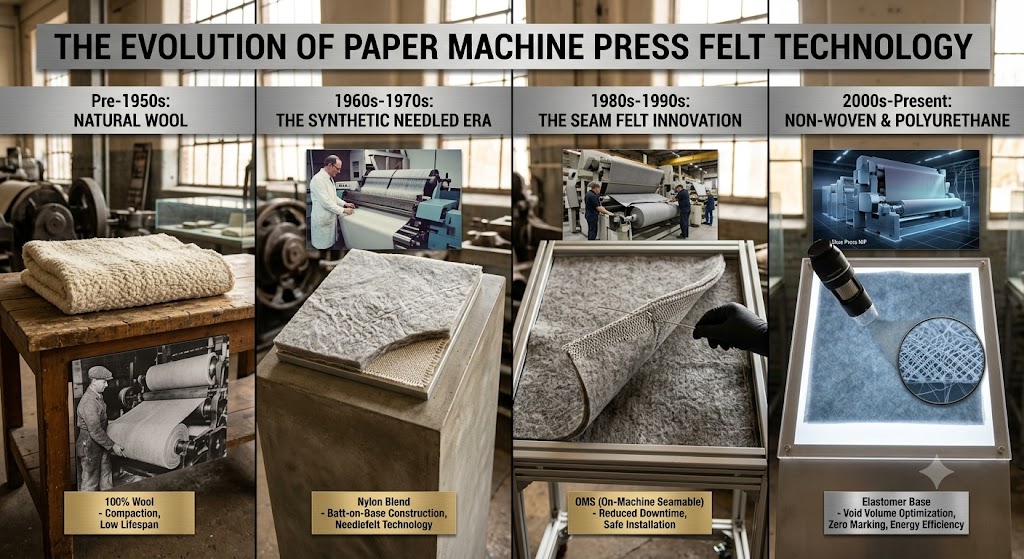
For centuries, dating back to hand-made papermaking and the early days of automated Fourdrinier machines, press felts were made entirely from 100% natural wool.
The Design: Wool fibers were spun into yarn, woven into a fabric pattern, and then deliberately shrunk and entangled (matted) to create a soft, absorbing blanket.
Limitations: While wool has excellent natural water-absorbency and cushion, it had major structural limitations. Wool felts compacted quickly under pressure, closing up the drainage channels. They were highly susceptible to stretching, tearing, chemical degradation, and bacterial rot, leading to a very short operational lifespan.
2. The Synthetic Revolution & Needled Felts (1950s–1960s)
As paper machines became wider and faster during the post-WWII industrial boom, traditional wool felts could no longer handle the increased stress.
The Blend Transition: In the 1950s, felt manufacturers began blending synthetic polymers (primarily Polyamide/Nylon) with wool, significantly increasing the fabric’s lifespan and resistance to friction.
The Introduction of Needled Felts: The 1960s marked the birth of modern press clothing with the invention of needlefelt technology. Instead of just weaving a blanket, manufacturers created a rigid woven base fabric and mechanically punched a web of loose fibers (the batt) into it using barbed needles. This decoupled the structural strength requirement (handled by the base) from the surface smoothness requirement (handled by the batt).
3. The Shift to 100% Synthetic & Advanced Bases (1970s–1980s)
By the 1970s, wool was completely phased out for high-speed applications in favor of 100% synthetic materials. Paper machines were transitioning to neutral papermaking, requiring tougher chemistry, and the industry was inventing new press configurations like “Tri-Nip” and early “Extended Nip/Shoe Presses.”
To keep up, felt construction evolved through several generations of base fabrics:
Batt-on-Base (BOB): A needled felt where the base fabric was made of softer spun synthetic/wool blend yarns.
Batt-on-Mesh (BOM): A massive breakthrough where the base fabric was woven from stiff, non-compressible monofilament (single-strand plastic) or multifilament nylon. Monofilament bases drastically increased the “void volume” (empty space inside the felt to hold water) and resisted compaction.
Weftless and Laminated Felts: To eliminate the cross-direction yarn markings on fine paper grades, manufacturers developed “weftless” felts (parallel machine-direction yarns with minimal cross-yarns) and laminated felts (stacking 2, 3, or even 4 independent base fabrics on top of each other). Lamination allowed the bottom base to be highly rigid for water void space and the top base to be incredibly fine for sheet smoothness.
Evolution of Structural Complexity:
[Woven Wool] ➔ [Batt-on-Base] ➔ [Batt-on-Mesh (Monofilament)] ➔ [Multi-Axial / Laminated]
4. The Seam Felt Innovation (Late 1980s–1990s)
Historically, changing a press felt was one of the most grueling, dangerous, and time-consuming tasks in a paper mill. Because felts were continuous, endless loops, heavy machinery rolls had to be cantilevered or partially dismantled to slide the new felt on.
Seam Felts (On-Machine Seamable – OMS): Introduced broadly in the late 1980s, these felts are manufactured open-ended. They feature integrated micro-loops woven into the ends of the base fabric.
The Impact: Mill workers could simply pull the open felt through the press section like a zipper, join the ends together, and insert a pintle wire through the loops to close it. This cut machine downtime for felt changes from half a day down to an hour or two, drastically improving mill safety and profitability.
5. Modern Era: Polyurethane, Vector Technology, and Sustainability (2000s–Present)
Today’s press felts operate on machines running at speeds exceeding 2,000 meters per minute under staggering nip pressures, often utilizing extended shoe presses. Modern technology focuses on microscopic engineering:
Non-Woven Base Technologies (e.g., Vector/Spectra): Moving beyond traditional weaving, some modern premium felts utilize extruded elastomer or polyurethane grids instead of woven yarns. This provides near-perfect elastic recovery (the felt springs back instantly after being crushed in the nip) and completely eliminates fabric yarn markings on the paper.
Advanced Batt Fiber Treatments: Batt fibers are now engineered with high-molecular-weight polymers and chemical coatings to resist “stickies” (contaminants from recycled wastepaper), oxidative biocides, and chemical cleaning agents.
Energy Focus: Modern press felts are explicitly simulated and designed via digital twins to maximize “dryness out of the press.” Pushing sheet dryness from 40% to 41% entering the dryer section saves millions of dollars annually in steam generation, cementing the press felt‘s role as an indispensable tool for sustainable papermaking.