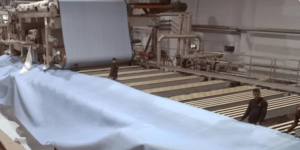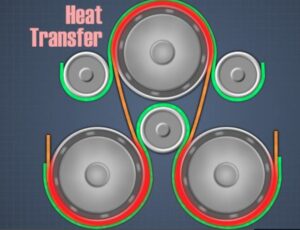
In modern high-speed papermaking, the drying section is a high-stakes engineering environment where the remaining moisture in a paper web is evaporated by passing it over steam-heated cylinders. The structural belts that hold the wet paper web tightly against these hot cylinders are known as dryer fabrics (or dryer screens).
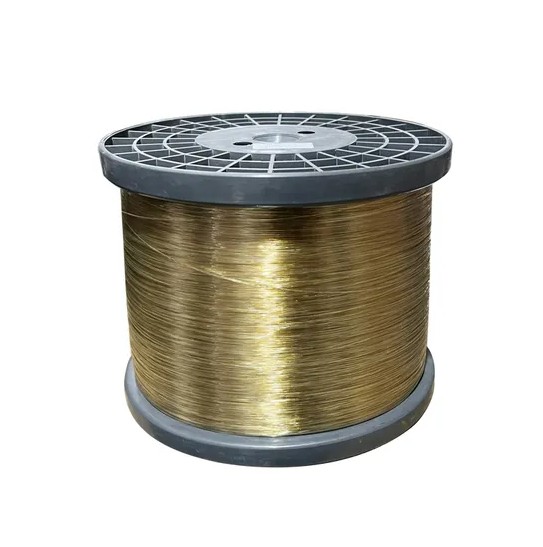
While Polyethylene Terephthalate (PET) has historically been the standard polymer for paper machine clothing due to its excellent dimensional stability and cost-effectiveness, it suffers severely under hot, humid conditions. This structural failure under heat and moisture—known as hydrolysis—causes PET to become brittle and degrade rapidly. To counteract this, modern high-performance paper machines rely extensively on Polyphenylene Sulfide (PPS) yarn to survive extreme thermal and chemical environments.
1. The Role and Performance Matrix of PPS Yarn
PPS is a high-performance, semi-crystalline thermoplastic known for its exceptional chemical resistance, thermal stability, and mechanical strength. When extruded as a monofilament or multifilament yarn and woven into dryer fabrics, PPS acts as a critical shield against the punishing conditions of the early dryer section.
The application of PPS yarn brings unmatched advantages to industrial papermaking:
Absolute Hydrolysis Resistance: Unlike PET, which degrades via acid- or base-catalyzed water cleavage at high temperatures, PPS features a chemical structure of repeating para-phenylene units linked by sulfide bonds. This backbone is entirely immune to hydrolysis.
High Thermal Tolerances: Standard paper machine drying cylinders operate between 130- 180 degree. PPS retains its physical integrity and mechanical strength continuously up to 200 degree.
Chemical and Oxidation Defenses: The papermaking process uses aggressive additives, whitening agents, and cleaning chemicals. PPS exhibits outstanding resistance to strong acids, bases, and oxidative wear.
Dimensional & Permeability Stability: Dryer fabrics must maintain a precise, uniform cross-machine direction (CD) shrinkage profile and steady air permeability to prevent paper defects. PPS yarn guarantees that the weave pattern does not warp or stretch over time.
2. Global Manufacturers of Dryer Fabrics and PPS Raw Materials
The global supply chain for PPS-driven paper machine clothing is divided into two tiers: the chemical giants that synthesize the advanced raw materials, and the advanced textile engineering companies that weave the yarn into complex, industrial fabrics.
Key Global Raw Material Providers (PPS Resins & Yarns)
Before becoming an industrial fabric, raw PPS resin must be synthesized and master-batched. Global market leaders include Toray Industries (Japan), which produces Torelina® PPS films and industrial resins, Celanese / Ticona (USA/Germany), known for Fortron® PPS, and specialty monofilament extruders like Perlon Group (Germany), who draw these resins into highly precise industrial monofilament yarns.
Leading Global Dryer Fabric Manufacturers
The final assembly and engineering of high-end dryer fabrics are dominated by a select group of global multinational firms:
| Manufacturer | Headquarters | Specialization & Technology |
| AstenJohnson | USA | Widely known for high-tier drying fabrics like MagnaTec, which utilize advanced, hydro-resistant structural weaves (Forughi et al., 2017). |
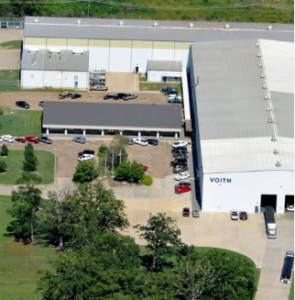
| Voith Paper | Germany | A leading titan in paper machine engineering, producing advanced Voith Paper Machine Clothing (PMC) optimized for extreme speed and thermal efficiency (Stenström, 2019). |
| Valmet | Finland | Supplies holistic machine clothing solutions designed to maximize runnability and uniform sheet drying (Stenström, 2019; Sorokovaia Jr, 2019). |
| Heimbach Group | Germany | Specializes in precision-engineered woven and spiral-structured dryer screens with tailored PPS/PET blend ratios. |
3. The Landscape in China: Rapid Scaling & Sourcing
China has evolved from being purely a major consumer of imported paper machine clothing to a dominant global force in both raw PPS production and integrated dryer fabric manufacturing.
Domestic Chinese PPS Raw Material Giants
China has achieved structural self-reliance in high-performance polymer synthesis, with domestic manufacturers operating at scale:
Zhejiang NHU Co., Ltd. (Zhejiang Xinhecheng): A prominent chemical manufacturer producing high-grade PPS resins (such as the 11100F and 3514 series) widely utilized in structural composites and industrial filaments.
China National Chemical Corporation (ChemChina) & DunAn Group: Critical drivers behind domestic chemical infrastructure producing industrial-grade polyphenylene sulfide materials.
Prominent Chinese Dryer Fabric & Industrial Textile Manufacturers
Chinese manufacturers have steadily moved up the value chain, supplying reliable, high-performance PPS-engineered fabrics domestically and exporting them globally:
Guangzhou Keylife Textile: A large-scale paper machine clothing producer manufacturing single, double, and multi-layer woven dryer screens, frequently blending PPS yarn to client specifications for imported or high-speed paper machinery.
4. Engineering Outlook: Material Trends
Because pure PPS yarn is highly expensive compared to traditional polyester, modern fabric design rarely relies on full pure PPS screens unless the environment is extremely severe. Instead, textile engineers deploy strategic blending.
By alternating PET and PPS yarns in the warp (lengthwise) and weft (crosswise) configurations, or wrapping a PET core in a defensive PPS sheath, manufacturers can extend the life of a dryer fabric by 200%- 300% while controlling material costs. As paper machines aim for faster line speeds and reduced energy consumption, the inclusion of PPS in industrial textile design remains a critical benchmark for high-performance papermaking.