1. Raw Yarn & Weave Architecture Control
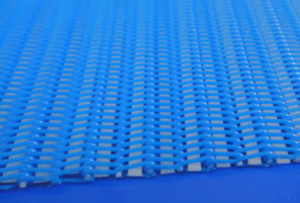
Monofilament consistency: Enforce strict diameter, roundness, and shrinkage tolerances on polyester (PET) and polyamide (PA) monofilaments; fine top-layer yarns govern fiber support and sheet smoothness, while heavier machine-side yarns provide wear resistance.
Balanced shed & binding geometry: Keep warp-to-weft float lengths and binder interlacing uniform across the width so air permeability (CFM) and drainage resistance do not drift from tending side to drive side.
2. Ultra-Wide Loom Rigidity & Tension Uniformity
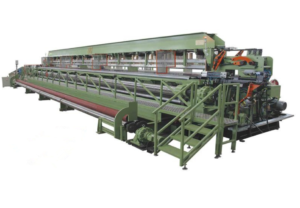
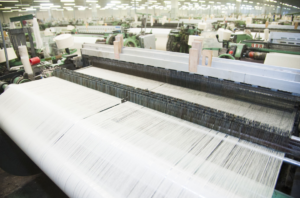
Beam and roll stiffness: Use heavy-duty, deflection-compensated warp beams, whip rolls, and reed/beating assemblies so center vibration or flexing does not alter pick spacing or beat-up force.
Equalized warp and weft tension: Monitor and balance tension across thousands of warp ends and across the full weft insertion width. Tension mismatches across the width produce bow, skew, or edge-to-center length differences that make the fabric wander or track unevenly.
3. Multi-Zone Heat Setting & Dimensional Stabilization
Cross-machine thermal uniformity: Control temperature and airflow across independent CD zones so heat distribution does not vary across wide spans. Even a few degrees of CD temperature drift can shift local shrinkage, elastic recovery, or permeability.
Controlled stretch and width hold: Apply calibrated MD tension and CD width restraint during heat setting to set target stability and prevent residual bow or skew.
4. Seaming / Endless Joining & Profile Verification
Precision alignment and seam finishing: Keep seam loops, pintle/joining elements, and edge trims aligned square to the fabric axis with smooth surface finishing so the joint does not mark the sheet or snag on rolls and suction boxes.
Full-width quality mapping: Measure air permeability, thickness/caliper, diagonal squareness, and a full-width CD reference marker across multiple stations before dispatch so any subtle CD drift is caught early
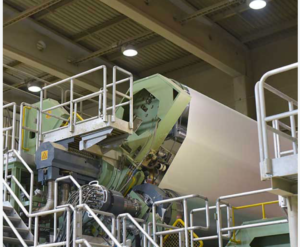
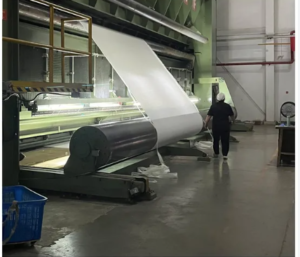
KEYLIFE‘s forming fabric can be up to 14m wide and has a very stable performance on wide paper machines